
The Writing Life
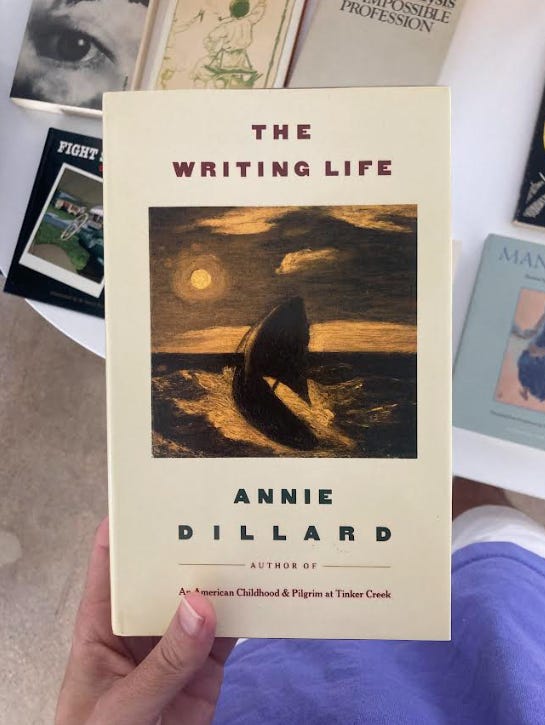
Writing lessons from Pulitzer Prize Winner, Annie Dillard

On pushing further
You have to surround yourself with work that expands your sense of what can be done on the page. Otherwise, you risk shrinking back into the comfortable familiar room of your own limitations. The room with the ordinary words, overused and overburdened, with the same structures and ideas you’ve been overworking for years. There is no experimentation and no hope for reinvention or renewal there.
There is an image in my head of my own creative capabilities, expanding out and contracting again, like lungs filling with air, pushing against the walls of the room where I write. By staying in the work, which involves pushing further and hunting for inspiration, I keep stretching the edges of my own abilities. The room you write from seems somehow bigger, the possibilities more vast.
Surrounding yourself with excellent writing stops you from regressing to the quick shallow inhalations that are so much easier than those deep sustaining breaths you are actually capable of. I can easily write sentences lazily, with half my attention, and have them dressed up and looking nice. But that won’t do. It’s like a beautiful looking meal made of gelatin1.
When my older brother and I were little, we’d visit our grandparents over Christmas holidays and sit on the Persian rug of their living room to play with legos. My parents would haul these massive bins full of them down from the attic. Once we had them, we’d spill them out over the rug, with all those wonderful colors. Then, we’d hover our noses inches above the lumpy plastic sea and begin to scan. We were searching for the best pieces, which you’d only know when you saw them.
I have to push further, spend more time picking through words and ideas like sifting through the legos, until I uncover the perfect one that clicks into place. The threat to this most days, is impatience which is really just tolerance for “good enough”.
On evaluating the work in progress: under the influence
The temptation to do so cannot be overstated, but I must resist the invitation to fall in love with my own reflection on the page.
I must also resist the opposite affliction, the nausea of consistently falling short of my own ambition week after week. While walking out into the air, it’s usually a bad idea to look down.
These twin hazards are always present. In the ecstatic aftermath of writing 2,000 words effortlessly I quietly wonder if I am writing the perfect novel. Then morning comes. I open my computer and begin to read yesterday’s work. What was surely glowing is now dull and scratched up. How could this be? What has happened to the expertly handled ideas I so deftly summoned? They’ve rotted overnight. A third grader tip-toed in and began banging on the keyboard, surely these banal cliches are not my own? Everything is lost.
Ian McEwan says that if you are unhappy with the last paragraph, the entire piece might turn to ash.
But if you are pleased by the last paragraph, everything else “springs back into life”.
The threat is always delusion, for better or for worse. Yet the threat can only be recognized and wrestled with, it cannot be cast out because we are unable to be objective as both the creator and audience-of-one for our works in progress. I am finding it better to reach for the analogy of drugs. Working on a large creative work is like ingesting a drug. You will see and think things that are not real. Those mirages are not enemies per se; the enemy is forgetting. Forgetting that you are under the influence. You must remember that your nightmares and ecstatic dreams are both fictions.
On saving the “good stuff”
Give your current work everything you have. Do not risk hoarding a part of your genius for some future dream.
“The temptation to save something for a future piece is a signal to use it now”
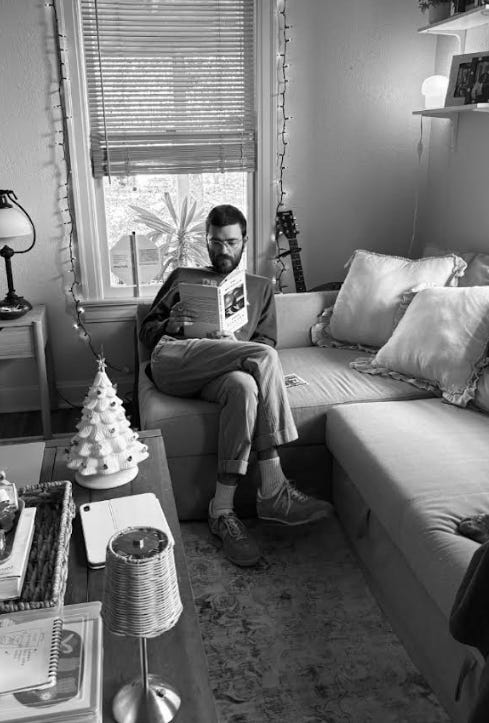
This is perhaps the single thing from The Writing Life that has ascended from mere advice to a mantra for me. Everything, nearly everything, can be folded in. The resulting richness, dissonance, and complexity is worth the effort.
like an LLM…